Showing posts with label Rocket Engine. Show all posts

Monday, 1 July 2013

S-II-T Saturn rocket

S-II-T Saturn rocket

A massive S-II-T Saturn rocket stage is installed on Nov. 18, 1965 for testing on what now is the A-2 Test Stand at NASA’s John C. Stennis Space Center. The S-II-T – known as “T-Bird” – was the first Saturn booster stage to be tested at Stennis, which then was known as the Mississippi Test Facility. Workers at the facility later would test the Saturn V first-stage booster for the Apollo Program that carried humans to the moon and back in July 1969.

Rocket long Engine 

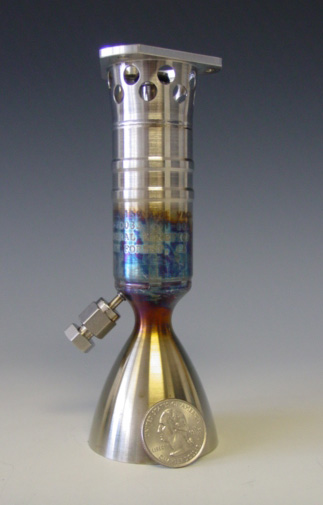
Rocket Engine Nozzle


 3D Model Rocket Engine


US Martian nuke-truck launches
The Centaur's engine, which produces 22,300 lb of thrust, fired up about 10 seconds later, then burned for seven minutes, shutting off exactly on time to place the MSL – and itself – in a "parking" orbit where it went into a 19-minute coast phase before a second 8-minute burn sent it into what NASA calls a "planetary trajectory".

That trajectory places the MSL on its way to Mars after separating from the Centaur booster 44 minutes into the flight – a moment that prompted applause from the space boffins assembled in the Kennedy Space Center.

All was not smooth, however. During the coast phase there were repeated brief – and disconcerting – data losses from the launch vehicle. The data losses continued to crop up during the coast phase, though NASA provided no details on their cause until 34 minutes into the flight, at which point the NASA commentator said that there appeared to be "a problem within the vehicle."

Each time the telemetry was reestablished, however, NASA reported that the data showed all systems to be operating as expected.

The 8-minute planetary trajectory burn began during a period of telemetry loss, though telemetry kicked back in soon afterward, showing that the burn levels were as expected. Thirty-six minutes into the flight, however, the NASA announcer said that "We are now seeing nice, clean telemetry data."

But with the spent Centaur booster now on its way to orbit the sun, and a healthy MSL spacecraft on its way to Mars, launch-vehicle telemetry is not a worry – NASA confirmed good contact with the MSL spacecraft, now on its own, 53 minutes into the flight.

When the MSL spacecraft's skycrane deposits the Curiosity rover [13] at Mars' Gale crater [14] next August, its primary mission will be to search out not life itself, but instead conditions conducive to life – at least organic life as we know it.

The Reg has written extensively about Curiosity and its goals and challenges. You can read a thorough mission overview here [15], learn more about the rover's plutonium power pack – and why is may be the last of its kind [16] – here [17], about its organic-compound-seeking Sample Analysis at Mars (SAM) experiment here [18], and meet the 12-year-old who named it here [19].

There's much more Reg rover goodness and other Martian intelligence to be found by simply typing "NASA Mars" into the "Search site" field in the upper right of this page – possibly enough to keep you busy until August 2012, when we most certainly hope that we'll report that Curiosity has successfully touched down at the Gale crater, and that its scientific studies have begun.

Racing Rocket Engines

Racing Rocket Engines

Engine parts:
1. Composite Compressed Air bottle, 1.1 liter, 300 bar
2. Pressure control regulator.
3. SS Peroxide Tank 9 liters, 22 bar, with safety relief valve and pressure gauge.
4. ¾” flow control ball valve, SS
5. Catalyst package chamber. Di = 81 mm.
Catalyst package at testing was 37 discs of solid silver wire screens plus 95 discs of silver plated SS screens.
6. Rocket Nozzle. Throat D = 38 mm. Exit D = 52 mm


The engine has the following calculated performance at maximum peroxide pressure, 22 bar, in the peroxide tank:

Thrust 142 kp =1390 Newton
Peroxide consumption 0.95 liter/second. H2O2% =85
Running time with full tank, 9 liters 9.5 seconds

Rocket propulsion - Aerospace Forum - Information Technology


Rocket propulsion is a sophisticated structure, its principle is mechanics, thermodynamics (Thermodynamics), as well as the use of other related sciences. Rocket thrust from Newton's third law (Newton's 3rd Law, action and reaction). Fuel through the combustion chamber (combustion chamber) after combustion, will produce high temperature and pressure of the gas, and then through a nozzle (nozzle) and the acceleration and exhaust to the outside world. These gases push the rocket is the driving force. Rocket classified in the following:

     Gas acceleration method (Gas Acceleration Mechanism)
     Sources of energy (Energy Source)
     Thrust (Thrust Level)

Gas acceleration method (Gas Acceleration Mechanism)

     Heat (Thermal) eg: Average fuel rocket (propellant rockets)
     ESD (Electrostatic) eg. Ion engine (ion thrusters)
     Electromagnet (Electromagnetic) eg. MPD engine (Magneto Plasma Dynamic Thruster


Sources of energy (Energy Source)

     Chemistry (Chemical)
     Solar (Solar)
     Nuclear (Nuclear)


Thrust (Thrust Level)

     High (> 1 G) eg. Rocket
     Low (<1 G) eg. Thrusters


Rocket Features

Rocket with the average aircraft engines the main difference is: Aircraft engines can only fly in the atmosphere, but the Rockets can work in outer space, because it does not promote the use of air will be able to burn. So it will not be highly affected thrust (thrust independent of altitudes). In addition, its thrust - weight ratio of (thrust - weight ratio) is high.

Usefulness of the rocket

     Non-space applications
         Missile propulsion systems (propulsion system for missiles)
         Supersonic aircraft propulsion system (primary propulsion system for supersonic research plane eg. X - series)
         Takeoff auxiliary propulsion system (Assist take-off rockets forairplanes)
         Escape Device (ejection of escape capsule)
     Rocket
         Soyuz
         Titan IV
         Space Shuttle
     Space Usage
         Transfer orbit (orbital change, plane change, trajectory transfer)
         Track maintenance (orbital control, orbital correction)

Chemical Rocket Engines 


Chemical rocket engine (Chemical Rocket Engines) can be divided into:

     Solid rocket motors (Solid Propellant Rocket Engines)
     Liquid rocket engine (Liquid Propellant Rocket Engines)
     Hybrid rocket engine (Hybrid Rocket Engines)

Solid and liquid rocket rocket rocket is now more commonly used. In addition, there is a hybrid rocket --- solid fuel (solid propellants) and a liquid oxidant (liquid oxidizer). Also worth mentioning is that, now contains the most liquid rocket launch vehicle with the solid rocket that is, a rocket will first (first stage) is solid and the second is liquid.

Solid Propellant Rocket Engines 

Solid rocket fuel (fuel) and an oxidant (oxidizer) is a solid state storage inside the rocket projectile. Solid fuel rocket engine is mounted directly on the rear of the rocket, when the use of lighter use (Ignitor) triggered fuel combustion, produce thrust push rockets.

Main components:

     Igniter (Ignitor)

     Housing (Casing)
     Nuclear fuel (Grain)
     Nozzle (Nozzle)
 

Space Shuttle Solid Rocket Booster 

Liquid Propellant Rocket Engines 

Liquid rockets and solid rockets difference lies fuels. As the name implies, of course, is liquid rocket fuel in liquid form. The benefits of fluid which can be compressed (compressible), so the volume will be lower than the solid, the same density, the weight of the low. This is the liquid rocket reasons for the higher specific impulse.

Fuel properties

Liquid rocket fuel can be divided into storage and require special devices to save some time categories. Need a special device for the fuel pressurizing and cooling equipment necessary in maintaining the liquid state prior to combustion, such as LH2 and LOX. This type of liquid rocket fuel before launch will be entered into the rocket fuel tank (Fuel Tank).

Another type of fuel is in the general environment that exists in a liquid, does not require additional equipment to maintain. Early this type of fuel is highly corrosive and can not perennial storage, processing, or is in the process of transportation, safety measures need to prepare. Late liquid rocket fuels to be stored for long period of time the fuel tank, corrosion resistance is low. However, this is still a fuel storage life is certain, but significantly extended.

Benefits of the liquid rocket engine
  
 Rocket Engine f1 3d model

High detail rocket engine loosely based on the Rocketdyne F1 of the Apollo era. I say loosely based as it is not an exact replica. Big model. Not much is optimized or attached so you can mess with it. Everything is attached to a dummy so sizing the dummy will scale the whole model. I included a rocket exhaust with shock diamonds for you to play with also. Download as a separate item. Use video post with blur fire.


Nuclear Rocket Engine


An explanatory drawing of the NERVA (Nuclear Engine for Rocket Vehicle Application)thermodynamic nuclear rocket engine. The main objective of project Rover/NERVA was to develop a flight rated engine with 75,000 pounds of thrust. The Rover portion of the program began in 1955 when the U.S. Atomic Energy Commission's Los Alamos Scientific Laboratory and the Air Force initially wanted the engine for missile applications. However, in 1958, the newly created NASA inherited the Air Force responsibilities, with an engine slated for use in advanced, long-term space missions. The NERVA portion did not originate until 1960 and the industrial team of Aerojet General Corporation and Westinghouse Electric had the responsibility to develop it. In 1960, NASA and the AEC created the Space Nuclear Propulsion Office to manage project Rover/NERVA. In the following decade, it oversaw a series of reactor tests: KIWI-A, KIWI-B, Phoebus, Pewee, and the Nuclear Furnace, all conducted by Los Alamos to prove concepts and test advanced ideas. Aerojet and Westinghouse tested their own series: NRX-A2 (NERVA Reactor Experiment), A3, EST (Engine System Test), A5, A6, and XE-Prime (Experimental Engine). All were tested at the Nuclear Rocket Development Station at the AEC's Nevada Test Site, in Jackass Flats, Nevada, about 100 miles west of Las Vegas. In the late 1960's and early 1970's, the Nixon Administration cut NASA and NERVA funding dramatically. The cutbacks were made in response to a lack of public interest in human spaceflight, the end of the space race after the Apollo Moon landing, and the growing use of low-cost unmanned, robotic space probes. Eventually NERVA lost its funding, and the project ended in 1973.

National Museum of Flight
 De Haviland Gipsy
De Haviland Gipsy

Bristol Siddeley Stentor Rocket Engine
Bristol siddeley stentor rocket engine
 Blue Steel Guided Missile
(from Vulcan Bomber)


Mercedes D IIIa

Rolls-Royce Derwent V
RR Derwent V cutaway view

Rolls-Royce Conway
RR Conway

Rolls-Royce Dart
RR Dart view

Gnome 9N